David's BLOG
October 7, 2026
Murder Changes Everything
I will not tell you exactly what happens. That would rob you of the experience of reading it. But I will tell you this: a murder sets the entire story in motion.
William does commit it. And he is connected to it in ways that make him vulnerable, and in 17th-century Toulouse, under the watchful eye of the Inquisition, being vulnerable is almost as dangerous as being guilty.
Tomás sees the situation immediately and moves to exploit it. The Inquisitor, who already views Protestants with suspicion, now has a reason to act. Within days, the comfortable world William has always known begins to collapse around him.
What strikes me most, looking back at this moment in the story, is how quickly everything changes. One event. One person willing to exploit it. And a man's entire life is upended.
That is historically accurate, by the way. In the records I researched about Huguenot persecution, the pattern appears again and again. Ordinary people whose lives were destroyed not by dramatic conspiracies but by a single moment of vulnerability that someone with power chose to act on.
History is full of those moments. Most of them never made it into the books. I wanted this one to make it.
September 20, 2026
William's Flaw
I want to be honest with you about William Mellichamp at the start of this story. He is not easy to like.
He is young, comfortable, and accustomed to getting away with things. He moves through Toulouse with the confidence of someone who has never had to pay a serious price for his behavior. He takes people for granted. He does not think carefully about consequences. He is, in a word, careless.
I made him that way on purpose.
A character who starts out noble and stays noble is not very interesting to follow across four books and 350 years. I wanted William to have a genuine arc. He needed to be a man who changes because he has to, because the world forces him to look honestly at himself for the first time.
That transformation does not happen overnight. It happens slowly, painfully, through a series of losses and humiliations that strip away the comfortable life he has always taken for granted.
By the end of Book 1, William is a fundamentally different man than the one we meet in Toulouse. He has earned that change. And because I made the early William genuinely flawed rather than just slightly rough around the edges, the change feels real.
I hope readers will stay with him through the difficult early chapters. The man he becomes is worth meeting.
August 21, 2026
The Making of an Antagonist.
Every story needs a villain. In The French Inquisition, that role belongs to Tomás Bataille.
Tomás is not a monster in the conventional sense. He is something more unsettling, an opportunist. A man who dresses up self-interest as principle, who convinces himself that betraying a friend is righteous when it benefits him.
He and William grew up together. They were not close friends, but they moved in the same circles in Toulouse. William trusted Tomás the way you trust someone familiar. It's always the most dangerous kind of trust.
When trouble breaks out and William needs someone to stand by him, Tomás sees an opening. He aligns himself with the Inquisitor, takes the Inquisitor's money, and turns hunter. What began as social betrayal becomes something darker.
I wanted Tomás to be the kind of villain readers recognize. Not because they have faced an Inquisitor, but because they have known people who chose the comfortable side of a conflict at someone else's expense. The recognition makes him more frightening than any monster would be.
Writing about Tomás was one of the more interesting challenges of the book. I had to keep him human even when he was doing terrible things. A villain who is simply evil is boring. A villain who makes choices you can understand. That is the villain who stays with you.
July 30, 2026
The City of Toulouse.
Toulouse in the early 1600s was one of the great cities of southern France. It was prosperous, cultured, and deeply Catholic. It sat on the Garonne River, a hub of trade and learning, with one of the oldest universities in Europe within its walls.
It was also one of the most dangerous cities in France for a Protestant.
The Inquisition maintained a strong presence in Toulouse. The city had been a center of religious conflict for centuries, going back to the Cathar persecutions of the medieval period. By the time William Mellichamp was growing up there, the tension between Catholic authority and Protestant residents was woven into daily life. You watched what you said. You watched who you said it to.
William, being young and careless, did not always watch carefully enough.
Toulouse gave me a setting with real historical weight. A beautiful, sophisticated city with a dark undercurrent. William is not fleeing some bleak, oppressive backwater. He is leaving behind a place of culture, comfort, and everything he has ever known. That makes his loss feel real.
When I was researching the city, I was struck by how vividly the records describe it. The covered market, the brick buildings, the river traffic. I wanted readers to see it clearly enough to feel the weight of William leaving it behind.
July 13, 2026
Who Were the Huguenots?
If you have not heard the word Huguenot before, you are not alone. Most people have not. But they played a remarkable role in European and American history, and understanding who they were is the key to understanding William Mellichamp.
Huguenots were French Protestants, followers of the Reformed tradition that grew out of John Calvin's teachings in Geneva in the mid-1500s. They were not peasants or radicals. Many were skilled craftsmen, merchants, and professionals. They were clothiers, printers, silversmiths, weavers. Most were educated, hardworking, and deeply committed to their faith.
They were also targets.
The French Catholic establishment viewed them with suspicion and hostility. The Inquisition pursued them. Periodic waves of violence, most notoriously the St. Bartholomew's Day Massacre of 1572, decimated their communities. Thousands fled to Switzerland, England, the Netherlands, and eventually to the New World.
William Mellichamp is a Huguenot clothier. His trade, his faith, and his nationality all make him suspect in the eyes of the authorities around him. When trouble finds him in Toulouse, he has no institution to protect him, no powerful friends to appeal to, and no safe place to hide.
That is the world I wanted readers to step into. Not a world of kings and generals, but a world of ordinary people trying to live decent lives in a time that made decency dangerous.
July 1, 2026
Every story needs a starting point. For the Mellichamp family saga, I chose 1598, the year William Mellichamp was born in Toulouse, France.
That was not an accident. Europe in 1598 was a world in transition. The Renaissance had run its course. The printing press had been spreading ideas for 150 years. Martin Luther had nailed his 95 theses to a church door back in 1517, and the fallout was still reshaping the continent. Catholics and Protestants were killing each other in the streets, in the courts, and on the battlefield.
For a Protestant family living in Catholic-dominated southern France, 1598 was both hopeful and dangerous. The Edict of Nantes that year gave French Protestants (Huguenots) a measure of legal protection. But that protection was fragile and unevenly applied, and everyone knew it could be taken away.
William grew up in that world. He was born into a family that survived by being careful, staying quiet, and knowing who their friends were. He did not inherit his family's caution. That is what makes him interesting.
I wanted readers to understand the world in which William was born. It was already loaded with tension before he made his single mistake. His story did not begin with his own choices. It began with the century he was born.
June 15, 2026
I never set out to write a novel. I set out to find a man.
When I was in college, I came across a description in a reference book about a fellow named Mellichamp who printed counterfeit South Carolina money, traveled to Georgia to buy crops, and sold them back in Charles-Town. The scheme nearly bankrupted the newly founded colony of Savannah. That paragraph stopped me cold. My mother was a Mellichamp.
Who was this man? Where did he come from? What happened to him and to his family after him?
The essay sent me down a road I have never left. I started digging into genealogy records, history books, and anything I could find about the Mellichamp family line. What I found was not just one man but a whole chain of them, stretching back further than I expected, living through some of the most dramatic periods in history.
The more I found, the more I wanted to tell their story. Not as a dry genealogical record, but as a living narrative. Real people in real situations, reacting to actual events. People of the times in which they lived.
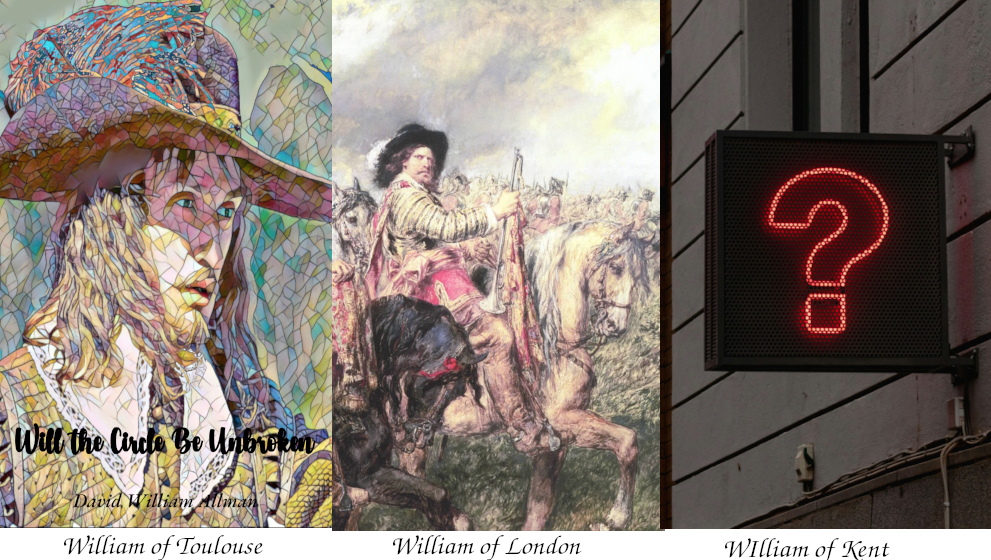
That is how Will the Circle Be Unbroken? was born. It began with a paragraph in a reference book and turned into the work of a lifetime. I hope you find it as fascinating as I have.
Or set up a chapter reading or signing event?
Contact David Allman